
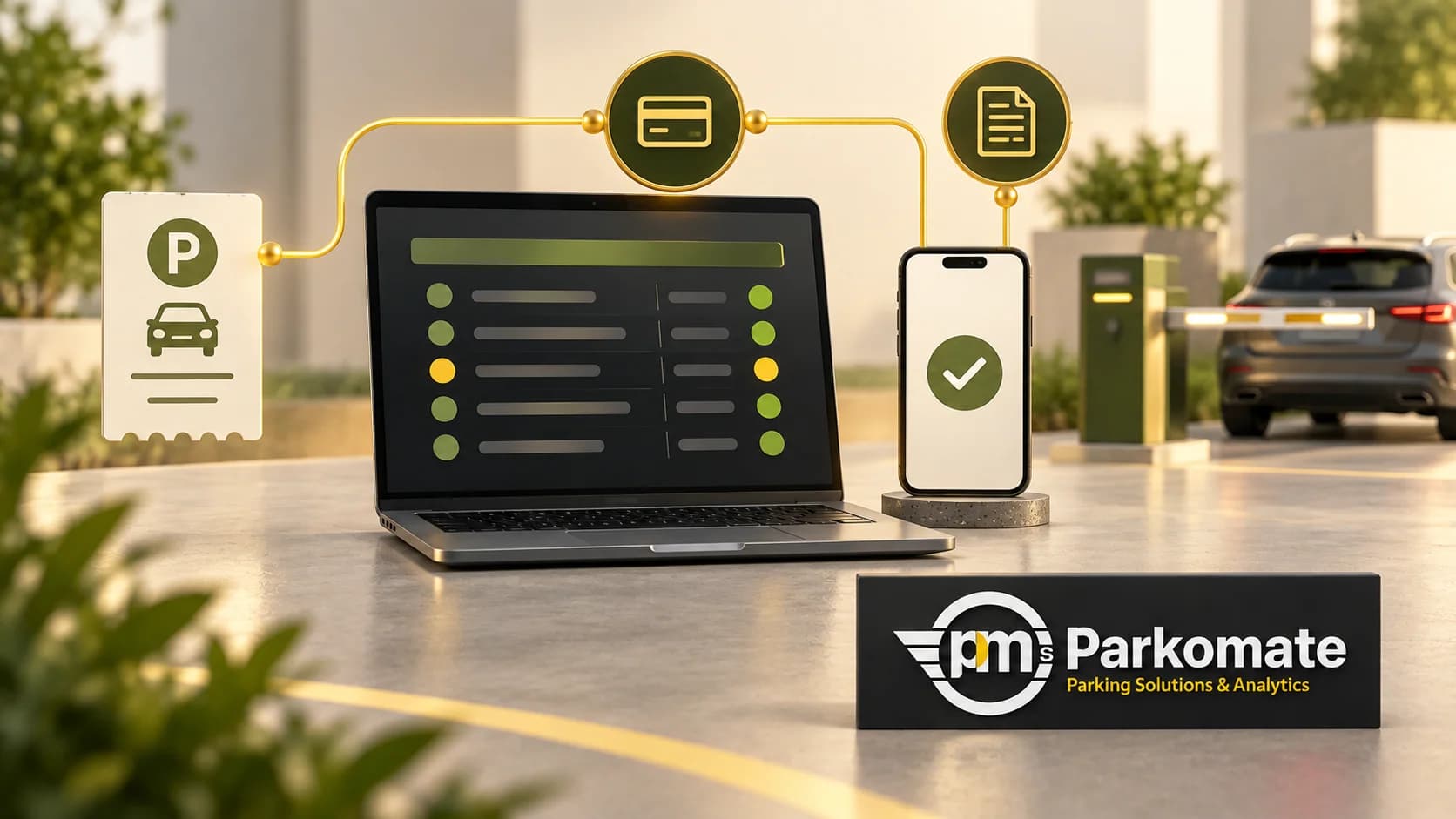
The customer shows a payment screen. The parking terminal still says unpaid. A queue is forming, and the attendant needs an answer. This is an operating situation worth rehearsing before a payment integration goes live.
Parking payment reconciliation connects the session, the approved charge, the payment record and the money received. It gives staff and finance a shared trail to follow when those records do not agree. A daily collection total cannot explain an individual disputed exit.
Give the parking visit one reference
Start with a stable session reference. Link its entry time, vehicle category, tariff and exit to the relevant payment references. If a customer attempts payment twice, retain both attempts so the second does not erase the first.
Keep the meanings clear. The parking session describes the visit. A payment record describes an attempt to pay. Settlement information describes money received through the agreed banking or provider process. Finance should identify the reports and cutoffs it uses to match them.
For UPI, NPCI directs merchants to their acquiring bank to check transaction status or raise a grievance. Its FAQ also describes refunds through the bank's defined process. Give your supervisor that approved escalation route rather than asking an attendant to resolve a banking dispute from a screenshot. NPCI's merchant UPI FAQs explain this boundary.
Rehearse the disputed exit
Ask for a demonstration with a successful payment, a pending result, a failed attempt and a confirmation that reaches the parking system later. Watch the operator screen as well as the payment record.
The team should be able to answer four practical questions:
- Which reference should the attendant search?
- What can the screen confirm, and what is still unresolved?
- Who may approve an exit while an issue is investigated?
- Where will finance find that outstanding issue after the vehicle leaves?
Also ask the integrator to test a repeated payment notification. There should be an agreed result for the receipt, session and lane action. Record it in the acceptance plan rather than assuming every integration handles the situation the same way.
Let the car leave only through an agreed exception process
An authorised exit and a settled payment are different decisions. If the supervisor permits a vehicle to leave, record the reason and responsible person while keeping the payment issue open for review.
Give the customer an approved reference and support route. Staff should follow the agreed site and payment procedure rather than asking someone to pay again because a local screen is slow.
Keep the exception list short enough for a shift team to use: pending payment, duplicate attempt, approved waiver, tariff correction, refund request and settlement difference. Each item needs an owner and a next action.
Make a zero-value session explain itself
Consider two illustrative visits with no recorded collection. One belongs to an exempt tenant; the other has a payment still under investigation. They may look identical in a total, but only one is finished.
A shift review should separate billable, validated and exempt sessions under the approved tariff rules. Then compare successful payments and reconcile money received using finance's chosen reports. Keep refund treatment and reporting dates consistent so yesterday's refund does not become today's unexplained shortfall.
Ask for the records before buying the dashboard
Request a sample session export, payment-attempt history, waiver approval and settlement review. Test a tariff change at its effective time and a refund after the original shift has closed. Check who may change a tariff, approve a waiver and review the audit history; those jobs need not belong to the same login.
Parkomate's Parking Management System includes billing audit logs and exportable reports in its published scope. Parking Analytics can support reporting, with revenue information where billing is enabled. Confirm the payment integration and exact reconciliation fields in the proposal.
The Pune mall deployment combines parking POS software with ANPR cameras for paid parking and vehicle logging. It is a useful starting point for discussing a linked vehicle-and-payment process, without assuming a particular bank or gateway was used there.
Does digital payment eliminate reconciliation? No. References help investigation, but exceptions and timing differences still need an owner.
Bring an anonymised sample shift report and one disputed-payment example to a requirements discussion. Those two records will make the demo more useful than a collection-total screen alone.