
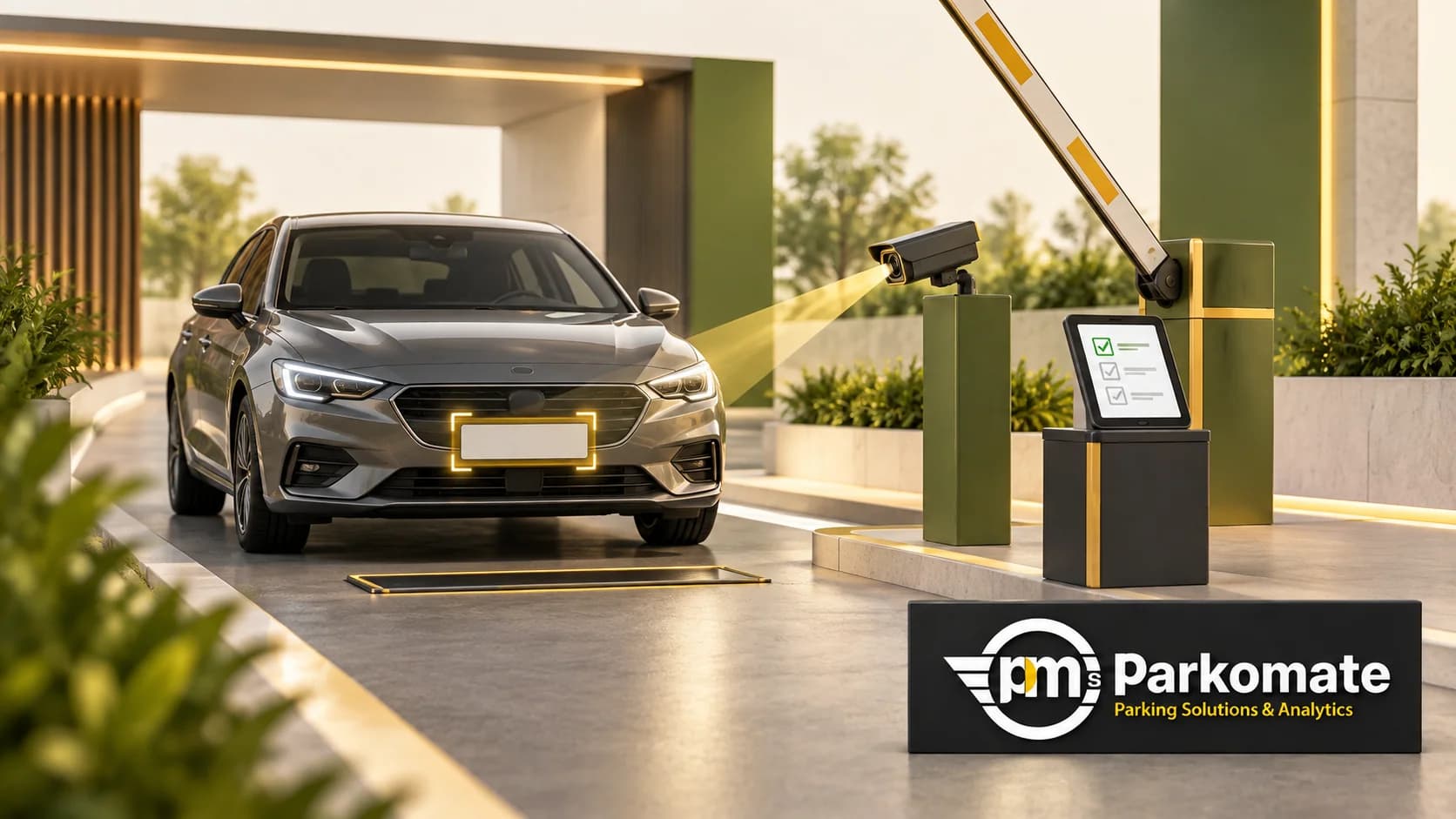
A familiar car reaches the office gate. Its plate appears correctly on the screen, but the barrier stays closed because yesterday's permission change has not reached the access list. Has the ANPR system passed its test? The camera has done one job; the parking operation still has a problem.
That illustrative situation explains what a useful ANPR acceptance test should cover: the plate read, the access decision and the operator's next action. Before signing off an installation, ask the supplier to walk through all three at your actual lanes.
Start with the vehicles your gate really sees
Make a short list with the security supervisor: employee cars, visitors, deliveries and any two-wheelers using the same lane. Agree which categories the proposed installation supports. A demonstration using a few selected cars says little about the rest of the traffic.
Observe normal daytime and after-dark operation. Include the stopping positions and busy periods that staff see in practice. If rain or another relevant condition has not occurred during commissioning, record it as untested and agree a later check. Keep tests within an approved operating plan; do not create a dangerous manoeuvre to challenge the camera.
Use a simple record for each passage: time, lane, vehicle reference, observed plate, displayed result and access outcome. Restrict access to that evidence and agree when it will be deleted with the facility's data owner.
Keep four results separate
- Did the system detect the vehicle?
- Is there a plate image that the reviewer can inspect?
- Does the automatic reading exactly match the observed plate?
- Did the configured permission produce the expected decision?
This separation makes faults easier to discuss. A missing image calls for a different investigation from a correct reading linked to an expired permission. If an operator corrects the number, keep that correction visible instead of treating the passage as an automatic success.
Ask what the percentage includes
An accuracy figure needs a denominator. Does it include every eligible passage, only detected vehicles or only the images selected as readable?
For an arithmetic example, 94 exact automatic matches from 100 agreed eligible passages is 94% for that test. It is not a Parkomate result or a proposed acceptance threshold. List the other six outcomes and any excluded passages. Otherwise two suppliers can report similar percentages while measuring different things.
Agree the required threshold before collecting results, along with the treatment of repeated passages by the same car. Your operations team also needs to know how much manual work remains at the busiest time.
Run the awkward access cases
Use approved test records for an authorised vehicle, an expired permission, a first-time visitor and a temporary vehicle whose permission is about to end. Ask an operator to correct a plate and a supervisor to review the original result and correction history.
Then test the agreed response to a camera or network fault under controlled conditions. Who makes the access decision? Where is it recorded? How does the next shift know that the lane needs attention? Barrier safety and emergency arrangements require their own competent-person checks; an ANPR read test does not settle them.
Match the equipment to the buying problem
For recurring office access, discuss ANPR Solutions, Parking Management System and Boom Barriers as connected parts of the proposed workflow. Plate identification, permission management and physical lane control each have a different job.
For paid parking, our Pune shopping-mall deployment page describes parking POS software and ANPR cameras working together. It does not establish a recognition percentage for your site. Use it to frame the session-and-vehicle workflow you want demonstrated.
Leave the handover with evidence you can use
Keep the lane plan, supported vehicle list, test results, unresolved issues, operator instructions and retest date together. Repeat the relevant checks after a camera is moved or its configuration changes.
Can existing CCTV be reused? Treat reuse as something to prove at the proposed lane. Ask to inspect both the plate image and the automatic result across the agreed test conditions.
Are manual corrections a failure? They are a separate operating outcome. Measure their frequency and the work they create without adding them to automatic-read success.
For a site assessment, bring a lane photograph or drawing and three access situations that currently make your staff stop and investigate.